Friday Faves — notes from the new gastroconomy, No. 25

a weekly round-up of our favorite finds from the front lines of food

  • Hey there, Comrade Farmer, the Pork Fairy, courtesy of Soviet propaganda.
  • SloPig takes the drama of heritage pork to the screen with a silent movie — heroes, villains, pigs and a damsel in distress.
  • It's Farm Bill time, and time to get active. The Senate is proposing a 50% cut to the most important young farmer training program in the nation. Put in your two cents.
  • Why we should love natural wines, and what all the fuss against them is about: "The real problem is the new popularity of natural wines. As long as they were fringe, they posed no threat. Now they are driving a growing market sector..."
  • Taco USA, NPR's On Point took a look at the evolution of Mexican food in America.

Friday Faves — notes from the new gastroconomy, No. 24

a weekly round-up of our favorite finds from the front lines of food


  • Camel milk chocolates and lattes — a traditional food finds new opportunities in modern tastes in Dubai with video of dairy camels (you saw it here first).

Sing Along Snacks: The Night They Invented Champagne

It's never too early or too late for a snack, so crank up that volume on your computer.

This week's Sing Along Snack is dedicated to our friends from A Year in Burgundy who are off filming in Champagne right now. From the musical Gigi, Leslie Caron sings this version herself as she asks with excitement:

"Is everybody celebrated, full of sin and dissipated?"

"The night they invented champagne, it's plain as it can be, they thought of you and me."


Spring Bounty: A Bevy of Scotch Eggs

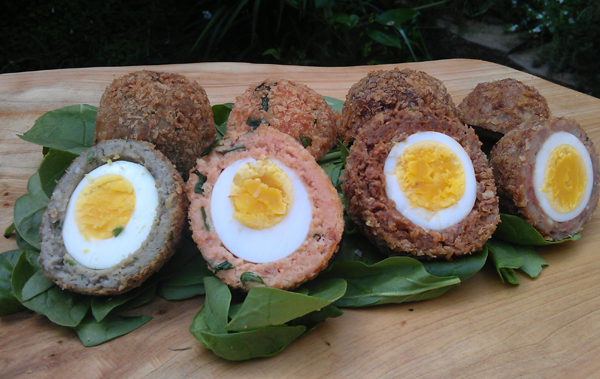
Scotch Eggs (from left) vegetarian, smoked salmon, merguez & pork sausage

Spring is upon us.  The days are getting longer, the sun getting warmer and the garden is getting weedier by the day.  But as the soil warms and the flowers poke their colorful heads up out of the ground, I start fielding questions from family and friends alike, “When are you going to make brunch?” 

Some people plan their garden, and some plan their brunch menus. I already know that this year I will be growing green beans and okra, both of which will be pickled and served up in the brunch-time Bloody Marys and the pineapple sage and boxwood basil will find it’s way into other fun libations. But to eat, I wanted to try my hand at Scotch Eggs.

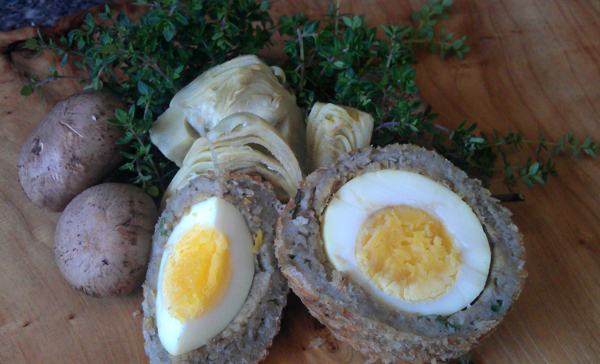
Meatless Scotch Eggs, with mushroom and artichoke.

Scotch eggs are fun to make and, once you have the technique down, you can try all kinds of flavors. To kick off the Scotch Egg escapades, I tried out four difference outer layers: classic pork sausage, lamb merguez sausage, smoked salmon and a vegetarian option, artichoke and mushroom.

The trick, especially when going outside the classic sausage outer layer, is getting the consistency right. For example, most fresh Italian style sausage can be used directly cut out of it’s casings, but for merguez, which often has a drier texture, you may have to add just enough beaten egg so that it sticks together and binds to the egg and itself. For the smoked salmon “mixture” I ground smoked salmon trimmings in a food processor with egg, fresh ground pepper and some panko bread crumbs. When I had a “sausage-like” consistency, I stirred in some chopped spinach. For the vegetarian option, I gently sautéed artichoke hearts with chopped button mushrooms and then ground them up with enough egg and panko until the consistency was “sausage or stuffing-like.” 

After coating each peeled, hard-boiled egg in it’s outer layer mixture, each egg was dipped in beaten egg, then rolled in panko bread crumbs and they were ready for the fryer. I kept the fryer on medium heat and fried each egg one at a time. Truth be told, they were pretty large so I didn’t want to jeopardize their shape or make my fryer over-flow. Just a couple minutes, gently turning the egg until they are cooked throughout, then gently scooped out to rest and cool on a bed of paper towels.

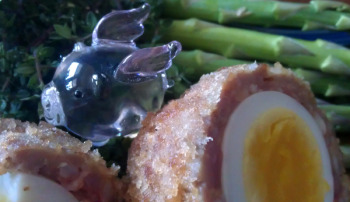
Traditional Scotch Egg, Pork Fairy approved.

Golden brown and a perfect blend of the crispy panko coating and the tender inner egg, a perfect set of Scotch Eggs!

I’ll be taking a set of these eggs to Easter Brunch to share with friends. For those guests who don’t eat pork, there are the merguez, salmon or vegetarian eggs. But, we all know which Penelope the Pork Fairy’s favorite will be!

Friday Faves — notes from the new gastroconomy, No. 23

a weekly round-up of our favorite finds from the front lines of food

  • With Easter coming up, we have eggs on the brain. The continuing popularity of the urban chicken trend and other city farm pursuits has prompted a new agrarian product line from Williams-Sonoma that includes stylish chicken coops, as well as DIY cheese kits and shitake mushroom-growing logs.
  • A Pork Fairy approved app for iPad that walks cooks through making bacon, pancetta and more: The Better Bacon Book.
  • Daredevil eating in Tokyo will get even more exciting as regulations on who can serve fugu ease. "I don't want people to forget that you can actually die from eating blowfish...I feel the government's awareness of this has diminished."

Sing Along Snacks: Rock Lobster

It's never too early or too late for a snack, so crank up that volume on your computer.

The B-52's looking 80's fabulous with possibly the only song on Earth to mention the obscure sea robin.

"In walked a jelly fish
There goes a dog-fish
Chased by a cat-fish
In flew a sea robin" (you get the picture, just dance it out)


Friday Faves — notes from the new gastroconomy, No. 22

a weekly round-up of our favorite finds from the front lines of food

  • An Atlantic vintage? A Pacific vintage? "You can think of the world’s oceans as a kind of rich broth. They’re full of salt, of course, but they also contain other ingredients, many of them vital to marine life and to the processes that control the Earth’s climate." Not strictly a food story, but we appreciated the metaphor.
  • Feeling nostalgic for one of our favorite culinary innovators, we happened on this Swedish Chef collection. Bork! Bork! Bork!
  • Usually, we go looking for the bizarre. Occasionally, it shows up in our mailbox, like this promotion for a bacon coffin. "We think that your final resting place deserves the eternal glory that is bacon." And Penelope the Pork Fairy says, "Amen."

Friday Faves — notes from the new gastroconomy, No. 21

a weekly round-up of our favorite finds from the front lines of food


  • Officials in Linköping, Sweden broke ground on an 18 story greenhouse located in town to be built by Plantagon. It will be "A new type of greenhouse for vertical farming; an international Centre of Excellence for Urban Agriculture; a demo-plant for Swedish clean-tech and a climate-smart way to use excess heating and CO2 from industries."
  • Chipotle discusses its use of social media: "Likes and retweets are great, but what matters most to Chipotle is genuine conversations with customers. Through these conversations, the social media team can share knowledge and gain insights that will ultimately make Chipotle restaurants even better."


Sing Along Snacks: Parmigiano Reggiano

It's never too early or too late for a snack, so crank up that volume on your computer.

Italian advertising delivers with a musical tribute to a classic cheese. These veggies have dance moves to put the Fruit of the Loom boys to shame.

"Ero annoiato ed abbastanza giù, Non c’era niente, neanche in TV
All’improvviso, tutto è cambiato, Del suo sapore mi sono innamorato."

[I was bored and quite depressed, There was nothing to do, and nothing on TV
All of a sudden, everything changed, I fell in love with his taste]


Hosting the Market — Tips for Farmers Market Managers

this piece was originally published March 15 in Seedstock, the blog for sustainable agriculture focusing on startups, entrepreneurship, technology, urban agriculture, news and research

It’s March and spring is just around the corner. As communities begin to thaw out, and regional farmers markets prepare to start offering their first spring crops, it’s a great time for farmers’ market managers to start planning their season. Farmers already have a lot to do, and market managers can play an important role in unifying and promoting the market.

It’s no secret that farmers markets are becoming more and more popular. According to the USDA, as of mid-2011, there were 7,175 farmers markets operating across the US. This is an increase of 17% from 2010. A new local food system is growing, but it needs a boost of more robust marketing and promotion to compete with the industrial food system. Many market managers come to the job through a love of food and farming and a desire to be part of a new food movement. This is a great call to action, yet to take promoting local food to the next level, managers need to take a page from the marketing and PR units of established companies. To pull in shoppers and create buzz you can’t just be earnest — you have to be fun.

Embrace the Role of Host

We explain our philosophy of promotion to new clients as hosting a party. We don’t push a product or service at people. Instead we cultivate an atmosphere around the product or service that makes it something people want to be a part of. Inviting people to be part of something allows them take ownership and builds loyalty.

A market manager is essentially a host of the market. Treat the market like your party. Welcome your guests. Make introductions between people who should know each other. Keep an eye on who’s getting along and who’s looking left out. Then invite more people.

Create a Strong Information Hub

Most farmers markets have a table or kiosk where market goers can find a variety of local information.  Some markets sell produce bags, feature recipes or information on regional tours, classes or places of interest. While that is fine, honestly it’s the bare minimum.

Market managers should make this the hub of information for both vendors and the public. Give the customers a place to go for reliable information for the days events or specials as well as what to look for in the future, thus giving customers something to look forward to. This is also a good place to clearly communicate the mission statement of the market along with its history. Consumers want to know the back-story of their food community and market too.

In promotion, you need to create events, which is most easily done by turning stuff that’s already happening into EVENTS! The distinction is largely a matter of presentation and enthusiasm. Signage should feature current market reports on what’s fresh and what’s coming next week:

“FIRST BERRIES are here! We are looking forward to a strong season. Bring on the pies.”

“Incredible asparagus across the market! Predicted heat alert — this may be one of the last weeks to have these tender tips!”

Start a countdown sign for a particularly popular item, especially at the beginning of the season when every new crop is eagerly anticipated. Advance notice helps build anticipation and buzz. Giving a heads-up about the end of a season encourages people to buy now.

Build Links Within the Food Scene

We’ve said it once, and we’ll say it again: great things happen when you connect the dots.

If there are chefs who regularly patronize the market, take it upon yourself to help promote that link.  Call out a local farmer-chef spotlight of the week on a chalkboard.

“Get your arugula at Farmer Jane’s stand, and taste it on the pizza special at Mario’s all week.”

By having rotating “local spotlight” menu items, patrons can taste the product prepared by a professional, which in turn validates their decision to purchase the product as well. It’s a tie-in to the local community that can be maintained beyond the day of the market. By bringing together the chefs and the farmers, consumers have access to a greater connection to both.

To keep the good feelings going past the “event” itself, start a binder for past menu spotlights, available at the information stand.

Invite Opinion Makers

Don’t be afraid to make your own connections with bloggers and local food writers. A good market manager can help spot trends, coordinate a story, and give a head’s up about what’s coming in or out of season. (For tips on how to set up and pitch a story see our DIY Press Savvy series.) It’s a great way to generate buzz for the market and a good skill for your resume.

To be a good promoter, think beyond what is required to what kind of impact you can have. Be bold, grab attention, and whatever you do, make it fun.

_____________________

About Alisha & Polly’s company: Polish Partnerships

www.polishpartnerships.com

Polish is a branding and communications company for the new gastroconomy. By creating strong partnerships with food and beverage producers, hospitality groups and industry innovators, we go the extra distance, transforming hopes, dreams and expectations into tangible, sustainable and polished realities.

Friday Faves — notes from the new gastroconomy, No. 20

a weekly round-up of our favorite finds from the front lines of food

  • Behold, the geekiest baking project ever (right) — Apple Pi
  • National Marine Fisheries Service's seafood inspection program intends to ramp up enforcement on fish fraud, busting the open secrets of the industry, like soaked scallops and over glazed fillet. "This sounds like something that is so simple, and so sort of pedestrian in the world of fraud, you would think ... people wouldn't get away with it....But it is absolutely a challenge."
  • The huge, unsexy and hard to address issue of food waste got coverage from Reuters. "Cleaning your plate may not help feed starving children today, but the time-worn advice of mothers everywhere may help reduce food waste from the farm to the fork, help the environment and make it easier to feed the world's growing population."
  • Pinterest is full of gorgeous food pictures. The online bulletin board for photo sharing is the latest social networking darling. Read some tips on promoting films, with plenty for food producers to apply.

Cephalopod Spotting

As we get ready to go to the International Boston Seafood Show, we have one of our favorite ocean dwellers on the brain — cephalopods. Everywhere we look, they're sticking their tentacles into the culture, from design to dinner.


Friday Faves — notes from the new gastroconomy, No. 19

a weekly round-up of our favorite finds from the front lines of food


  • Chefs differ in their enthusiasm for Yelp and making everyone a critic. Sometimes it's not half bad: "It used to be that if you got a bad review in the New York Times, you had to close. It was like the theater. There was only one guy who decided everything. There are so many more people reviewing everything today. Nowadays, if you get a bad review in the Times, you can still make it.”

A Farmer’s Guide to Working with Chefs

this piece was originally published February 23 in Seedstock, the blog for sustainable agriculture focusing on startups, entrepreneurship, technology, urban agriculture, news and research

Farmers and chefs have a lot in common. They both work long, often uncomfortable hours. They both suffer the whims of weather, from ruined crops to cancelled reservations, and they both depend on delivering a stellar product and pleasing others for their livelihood.

To make it in food — from the field to the kitchen — you need passion.  To make it in the food business, you need communication.

Communicate — Early & Often

No one knows your crops like you do, but for chefs to step-up and incorporate your product into their culinary rotation, they need as much lead time as possible to plan. No chef would be excited to see a mountain of fava beans show up unexpected on their doorstep….even if they were the absolute freshest and PERFECT!

Restaurants have a rhythm and, with a little lead time, they can make the proper staffing arrangements to tackle such a mountain of favas. In fact, given just a bit of lead-time, a chef can do all kinds of things that would highlight your harvest. (A special fava menu for the bounty you just laid upon the kitchen’s doorstep!) But they need to know what to expect as far in advance as possible.

As a farmer, if you can work to sync your harvest with the rhythm and pace of the restaurant, it will make for a much easier working relationship. Work the schedule backwards. Start by asking what the peak volume days are for the restaurant, then how much time they need to prepare whatever it is you are bringing. This will give you a better understanding of what it will take for you to deliver, and what it will take for the chef to do something great with your product.

Share Your Knowledge

Farmers are sitting on a ton of information about the food they grow. This is inspiring information for chefs! To show off your work to best effect in the dining room, chefs need to know more of what you know. The best way to transmit this knowledge to the chef, and then for the chef to pass it to the kitchen staff and wait staff and consumers, is to put it in writing.  Nothing fancy is required. An organized email or a printed one-pager that’s delivered with your products will do the trick. The description from the seed catalog and a few lines about how they were grown would be fantastic.

Beyond heirloom products, farmers often have heirloom knowledge. Chefs don’t like waste, and as they begin working with local and artisan production, they increasingly need to know how to pickle, preserve, butcher, and more. This is to keep the bounty working for them through the peak and into the menu long enough to actually use the complete harvest. Chefs are sensitive to what goes into raising food, and using everything to the fullest is how they honor and respect the production. That said, many cooks today lack the “old-school” education needed to properly execute these traditional preserving or preparation techniques. If there is something in your family’s past, or some bits of knowledge that have been passed on to you as a farmer or artisan food producer, ask the chef if they are interested in trying out your methods. It might bring a new dimension to your relationship.  The more ways they have to use your product, the more they can buy from you.

Chefs may want more than they know. They might want a common varietal because they don’t know what else is out there. Chefs have become accustomed to standard products because they’ve been cut off from the actual farmer or fisherman. Ideally, as the connections between farmers and chefs are solidified, they can become partners in experimentation, and partners in building strong, diverse food communities.

Set Expectations 

Farmer hours and chef hours are very different. Come up with a mutually acceptable time to talk. This will make communicating much easier and more efficient for you both.

Provide the chef with a volume estimate of what they can expect. You know your production inside and out, but don’t assume the chef intrinsically understands or can estimate how much he will receive.  Remember, a restaurant kitchen is a very busy place with many moving parts. Even if told two weeks in advance how many cases of your special heirloom vegetables they can expect, chances are good that the chef will have forgotten the details of the case count. A gentle reminder will keep the communication flowing and eliminate surprises.

The Benefits of Understanding

When the connection between producer and chef is reestablished, great things happen. Take a look at Chef Richard Garcia at the 606 Congress, located in the Boston Waterfront Renaissance. It’s a big hotel, and he serves a lot of fish. After establishing a local relationship with a few fishermen, Chef Garcia has been able to move beyond stating exactly which fish is going to be on the menu. The fisherman will call or text him from the boat about what they’re catching. One day it could be haddock, the next day it might be sea robin. His waiters are all up to speed on the program and share the information willingly with the customers. His customers know that it will be the freshest fish that happened to land that day, and it will be from one of his local fishermen. The chef gets variety and the freshest fish available. The fishermen get a market for everything that lands in their net.

By keeping each other in the communications loop, they manage each other’s expectations and needs for a mutually beneficial business relationship and a more sustainable local food system.

_____________________

About Alisha & Polly’s company: Polish Partnerships

www.polishpartnerships.com

Polish is a branding and communications company for the new gastroconomy. By creating strong partnerships with food and beverage producers, hospitality groups and industry innovators, we go the extra distance, transforming hopes, dreams and expectations into tangible, sustainable and polished realities.

Friday Faves — notes from the new gastroconomy, No. 18

a weekly round-up of our favorite finds from the front lines of food

  • If you thought bacon and mint sounded weird, how about champagne and graffiti for a real high-low mash up. Moët & Chandon has teamed up with graffiti artist André for a limited edition "Tag your love" packaging for its Rosé Impérial champagne. (video at bottom of the page is priceless)
  • The latest farmer-chef collaboration getting some buzz — bespoke syrups.

"You drive me to confess in ink:
Once I was fool enough to think
That brains and sweetbreads were the same,
Till I was caught and put to shame,
First by a butcher, then a cook,
Then by a scientific book.
But 'twas by making sweetbreads do
I passed with such a high I.Q."

Makin' Bacon

It’s an understatement to say that bacon is one of the most cherished and sought after ingredients in my home kitchen.  Its added to so many things, I can’t even begin to list them.  But we have always had a small problem in that my youngest daughter is allergic to nitrates. I’ll spare you the details, but lets just say it’s been enough to put her off most processed meats “just in case.”   It’s also affected my grocery bill. No run-of-the-mill ham, charcuterie or bacon for us. Nope — just the good stuff!

So that got me thinking:  I’m a chef and a mom, with a backyard cob oven and an assortment of barbecues. It’s time to make our own bacon!


Step One:  research, research & more research

So how DO you make bacon? What are the various cure processes, times and ingredients? How long do I smoke it, with what wood, and at what temperature?

All these questions led me to many wonderful online bacon references that I used to piece together a bacon plan. (see end of post for a list)


Step Two: meat + salt & other stuff + time = when do we get to eat it?

meat

I took a friend to a wholesale market, and on the way I explained the bacon plan. I had not thought about actually looking for the pork belly yet.  I mean, after all, I hadn’t settled on a cure!

As we toured the meat section of the market, she stopped in her tracks and said, “Hey, Polly, is this what you are going to use for your bacon?” Yup, there it was: one single pork belly (half) sitting right there.   I couldn’t believe that I had just walked past it, not even giving it a second glance.

So, now the pressure was on.  I couldn’t ignore the pork belly, and I had a witness.  Given that she had to listen to all my glorious planning while in the car, I had to do it.  No choice. Buy the belly.

salt & other stuff

I had not yet ordered any curing supplies, so I scrambled down to my pantry and found a bunch of kosher salt, black pepper and sugar. Internet, don’t fail me now! In good seat-of-the-pants chef style, I put together a dry cure recipe and set out to start the bacon project.

time

Each day I checked the cure, drained off liquid and reapplied the mixture. This went on for four days. Admittedly, I am still unsure of this actual step and look forward to playing around with time and the cure recipe.  It looked good, smelled very nice and thankfully the look of a slab of meat covered in salt seemed to keep the teenagers at bay.  But I did learn something.  This type of project, as far as teenage appetites are concerned, is like taking a long road trip.  It’s a culinary version of “are we there yet?” just transformed into “when do we get to eat it?”


Step Three: smoking

When the bacon was ready, or at least when I thought it had sat long enough in the cure, it was smokin' time. Before you can start to smoke the bacon, it has to dry.  Putting wet meat into a smoker is definitely not an option.  The meat needs to air dry so that a nice pedicure of proteins form on the surface and allows the smoke to penetrate.

The thought of air drying the bacon slabs in my wine cellar was appealing in sort of a romantic way.  After all, it's cool, has good air flow and who doesn't fantasize about having a cellar full of wine and air dried meats....but I digress.

My cellar is probably a fine place for the bacon, but it was winter and the pantry is next to the cellar, but boasts of a finished floor and ceiling. The pantry won out.

The ambient temperature of the pantry was pretty cold, but I installed a small fan just to keep the air moving. The next problem was where and how to hand the meat.  I had a handful of "s" hooks, so I knew I could hang it, but what to hang it on?  Solution: an accordion style laundry drying rack. Perfect!

When the meat was dry, I put it back into the refrigerator before setting out to create the smoke.  

Before I invest in a dedicated backyard smoker for the foreseeable vast volumes of bacon I will ultimately need to produce to satisfy the teenagers, I figured I would try to transform my gas grill into a temporary bacon makin’ machine.  Since it has a thermometer on the outside and staggered inside racks, I reasoned that this would allow me to “hang” the bacon and watch the temperature without having to lift the cover and let out the precious smoke.  I started with soaked apple wood chips smoldering away in a heavy tin. Once I placed the bacon and closed the lid, it was time to wait it out.

Handfuls of chips and 4 hours later, we couldn’t wait any longer.  It smelled so good; we just had to get to that smoky slab.  We took the pieces out and put them into the refrigerator to firm up before trying our hand at cutting strips.

The belly firmed up and was a beautiful creamy color, not very “smoky” looking, so we cut it into strips with a very long, sharp slicing knife. It was pretty difficult and each family member figured they could do it the best. The result: a stack of scraggly looking, irregular bacon strips. No matter, once in the frying pan it all just starts to look delicious.


Results

Good. Nice pork taste and color but very salty and not quite as smoky as we would have thought.  I expected the meat to turn browner than it did since I didn’t use any type of saltpeter. Compared to store bought, run of the mill bacon, ours took longer to render the fat and it seemed to go from limp to crispy in a flash. 

All in all, this was a good result for the first attempt. Over the next few weeks, we made our way through the slabs, making sandwiches, breakfasts and stir-fries. The rind was sliced off and put into stews, soups and pots of beans. The fat from all our cooking was collected and stored for a future tamale project.

We will definitely try again, very soon in fact. I plan on lining up a dry vs. wet cure-off. Our days of playing with bacon are here to stay. 


Here are some of the sites I used for inspiration and confidence building!

http://keepingthefarm.blogspot.com/2011/03/curing-bacon.html

http://www.robbwolf.com/2011/05/20/the-path-to-culinary-bliss-home-cured-bacon/

http://nchfp.uga.edu/publications/nchfp/lit_rev/cure_smoke_pres.html


Sing Along Snacks: Crawfish

It's never too early or too late for a snack, so crank up that volume on your computer.

Happy Mardi Gras! Leave it to New Orleans to make a tiny crustacean sultry. Elvis could sing them right out of the water with this song from the 1958 film King Creole

"Now take Mr. Crawfish in your hand
He's gonna look good in your frying pan
If you fry him crisp or you boil him right
He'll be sweeter than sugar when you take a bite"